RADV audits no longer operate well through spreadsheets, disconnected coding tools, and manual chart tracking.
Charta’s RADV platform was built to give Medicare Advantage plans a centralized operational layer for retrieval coordination, evidence management, HCC validation, and submission readiness across multiple simultaneous audits.
Here are five capabilities that fundamentally change how RADV operations are managed:
1. Real-time validation progress at a glance
Most teams fall back on their existing coding platforms for RADV and other HCC validation exercises. But coding platforms don't provide centralized visibility across an entire validation process, from chart pursuit to best record selection—let alone give team leads a bird’s eye-view of multiple, simultaneous audits. Charta does, and it's the first thing you see when you open a project.
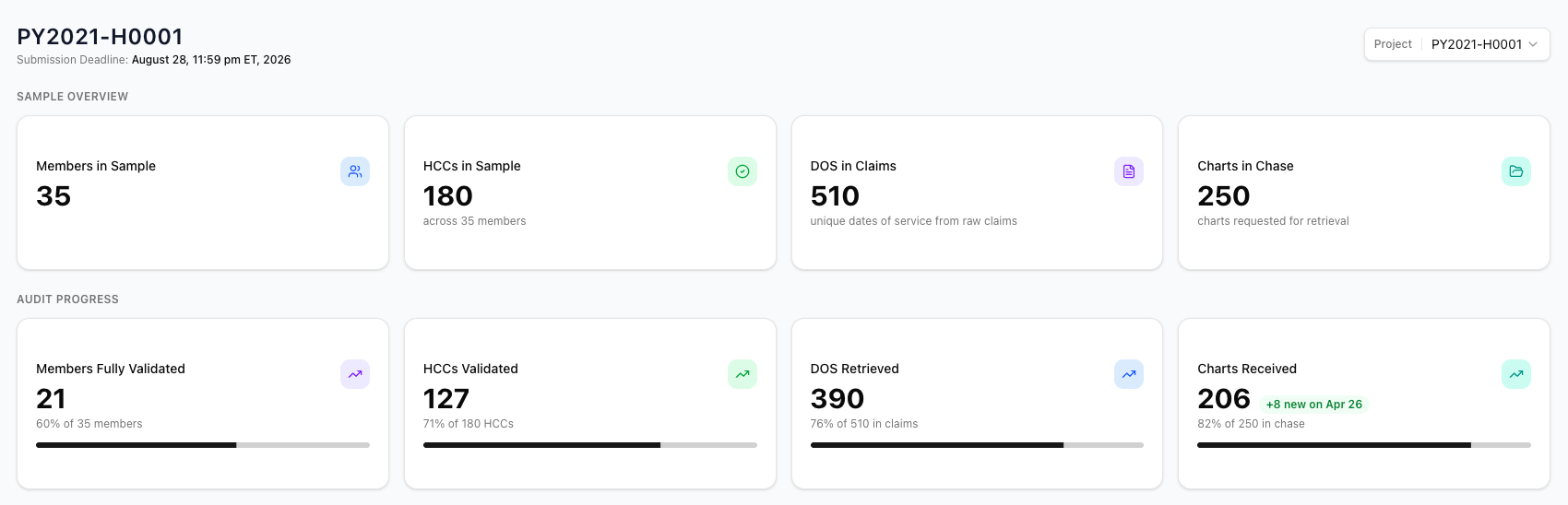
At any given moment, you can log on to Charta to see exactly what percentage of charts have been retrieved, what percentage of HCCs have been validated, and how each member of your team is performing against their code validation assignments. As the team lead, you can analyze validation status by project, by round, and by member, without having to ask members of your analytics team to build a report and then waiting to hear back.
For project leads managing multiple validation rounds simultaneously, this shift alone is transformational: You can monitor three RADVs at once without maintaining three or more separate spreadsheets that inevitably fall out of sync.
{{CTA-BLOCK}}
2. A powerful AI engine for matching charts to claims
In RADV, every obtainable chart tied to a sampled member could matter. The operational challenge is determining which records should be pursued first, which are most likely to validate the audited HCC, and how to efficiently organize the resulting evidence once charts arrive.
This is where Charta diverges most sharply from traditional coding tools: Charta uses intelligent LLMs and a proprietary matching technique to scan charts as they arrive and immediately pair and arrange them alongside the relevant claims. This saves your team hours of effort matching charts to claims.
Charta also renders obsolete any process for sorting and storing the charts in folders or archives where coders can find and reference them. Behind the dashboard, the charts are intelligently linked to the relevant claims as soon as they’re received.
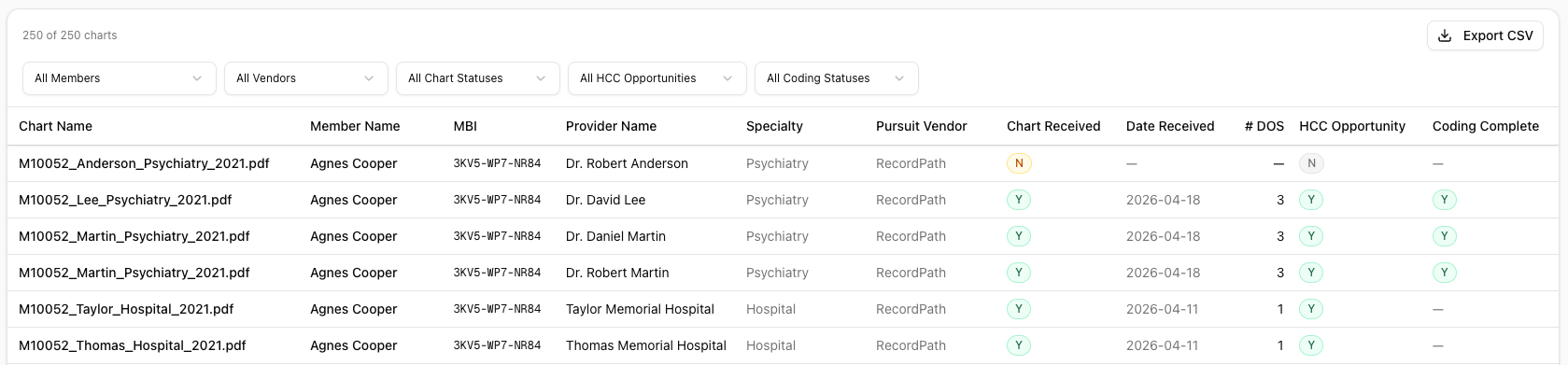
This streamlines the way the entire validation process unfolds. A standard coding platform loads up charts for a given patient. Coders then open a chart, read through it for validation evidence, and move on. They have no systematic way of knowing whether the dates of service they're reviewing will map to a claim requiring validation, or whether they're missing any claims entirely.
Charta doesn’t just match charts; it also parses them by date of service, allowing your team to focus only on the pages that matter. The same goes for cases where a single patient visit generates claims across multiple providers (such as a lab draw in one place, an imaging study somewhere else, all on the same date of care).
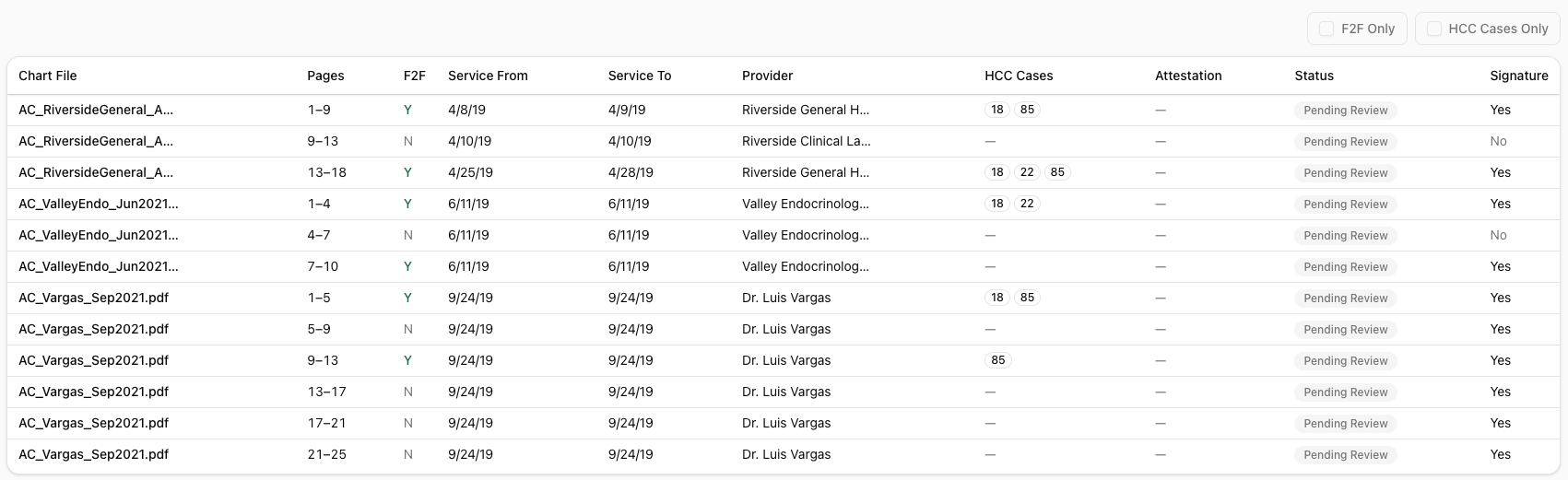
As a result of this automated linking, your team’s work is focused only on what matters. With the organizational work of marrying up charts and claims done for you, your coders get to do what they do best: analyzing clinical documentation for HCC support—not rifling through pages of irrelevant data looking for what they need. Instead, they click on a member’s name, see exactly which HCCs still need validation, and know precisely which charts have arrived and contain relevant evidence that’s ready for them to review and validate.
3. A smart work queue for efficient member assignments
Charta's validation work queue not only maximizes a team lead's visibility into progress across projects. It also makes assignments of members effortless, and coder activity easy to monitor and evaluate.
As soon as you load the member sample for your validation project, Charta lets you choose team members to add to the project. You can then assign each patient in the sample to a team member with just a few clicks. Each coder sees their assigned members and the associated charts, eliminating distractions.
If someone on your team falls behind or finishes early, reassignment is just as fast. From the team leader's view, you can see every team member's progress in real time, including how many HCCs they’ve validated, which charts they’ve opened, and how many dates of service they’ve reviewed. The platform also calculates additional productivity metrics, such as charts reviewed per hour.
This automation replaces what is, in most organizations, still a full-time job for someone: building and maintaining the spreadsheet hygiene that keeps an HCC project from coming apart at the seams, causing validations to fall through the cracks.
With Charta, patient assignments and daily progress assessment becomes a two-minute task.
4. AI-assisted HCC validation workflow
At the heart of Charta’s RADV workflow is an AI coding engine trained on clinical documentation review and HCC coding. As soon as records are ingested, the engine matches charts to patients and parses records by date of service, to determine and visually signal to coders which dates of service within the chart contain evidence for validating a patient HCC.
This makes the coder’s simple and straightforward: Once a coder is inside a member's record, Charta's engine has already done the heavy lifting. Rather than requiring the coder to search the full chart for evidence of each HCC, Charta pre-parses the record and surfaces source documentation alongside the HCC code it’s meant to validate. Coders simply review and rate the evidence as valid or invalid. For each HCC validated, the coder can also rank the support on a scale of 1 to 5, giving teams easy prioritization for submitting the best records as submission dates approach.
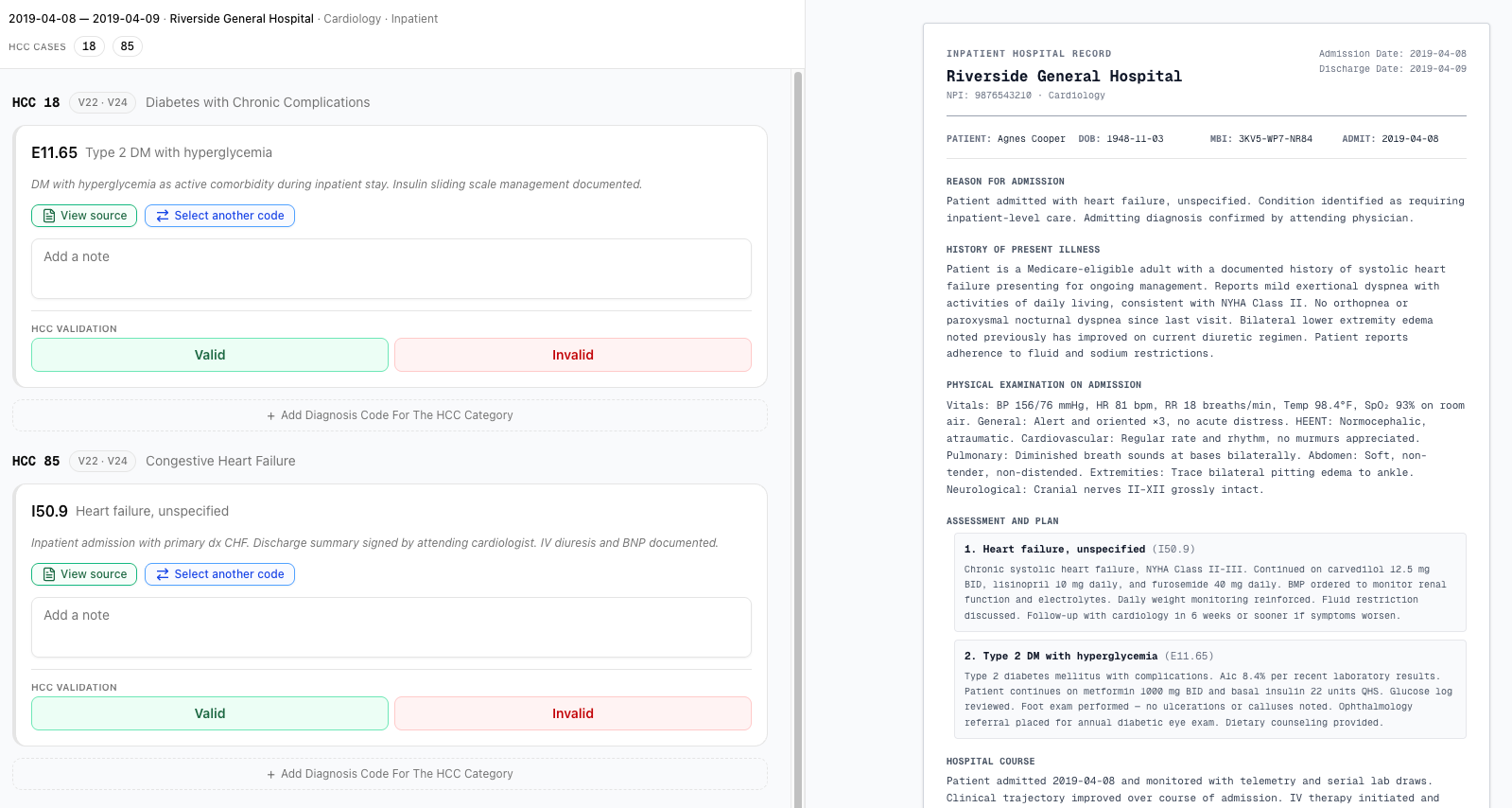
If the coder spots an HCC that was missed entirely—for example, a chronic kidney disease diagnosis co-occurring with diabetes, they can add it directly in the workflow.
As coders progress through the validation process, the platform tracks what's been validated and indicates the status of each HCC visually: Codes turn green as they're confirmed, giving both coder and lead an at-a-glance view of exactly where each member stands.
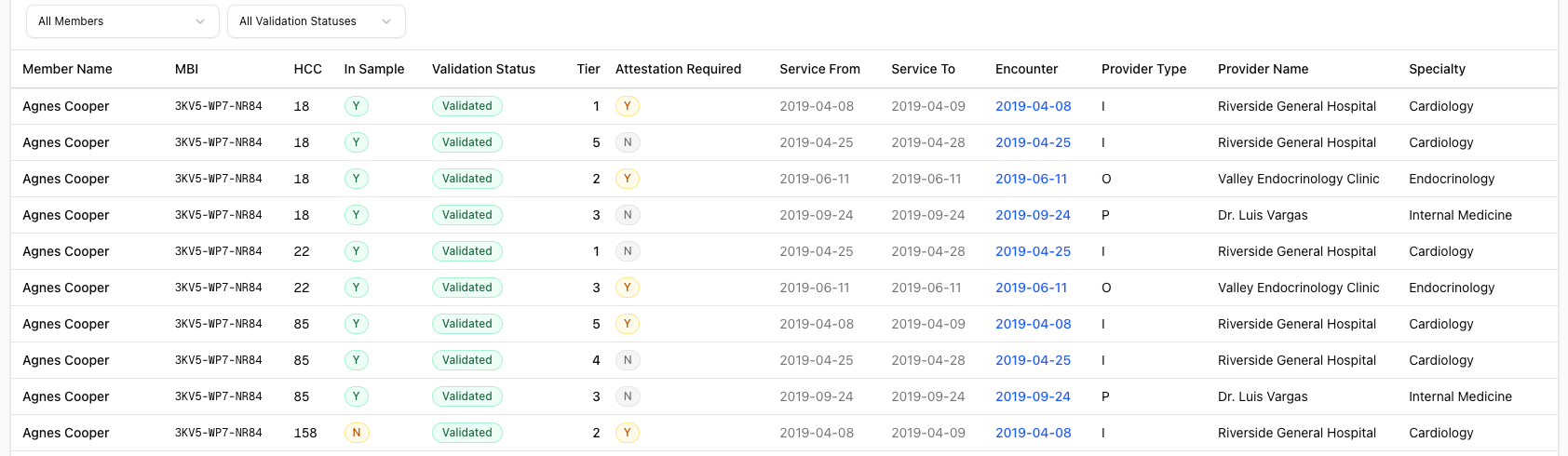
With conventional coding platforms, coders are often forced to manually navigate lengthy charts and search through multiple encounters to determine which dates of service may support the audited HCC, with reviews taking anywhere from 15 minutes to over an hour per record depending on chart complexity. Charta streamlines this workflow by organizing charts around the encounters, claims, and diagnoses most relevant to the targeted HCC, allowing coders to move directly to the dates of service most likely to contain defensible supporting documentation. Coders can also quickly surface and reference the exact evidence used in validation decisions, improving review efficiency while strengthening audit defensibility and consistency across coding teams.
For organizations running large validation projects, the productivity multiplier is significant.
5. Best record selection and operational reporting
In a RADV, success isn’t just about validating diagnoses: it’s also contingent on identifying the strongest and most defensible records for submission. Charta’s best record selection workflow helps teams organize charts around validated evidence, outstanding gaps, overall documentation strength, and visibility into records that may both validate the audited HCC and contain additional incremental HCC opportunities—all without manually reconciling spreadsheets across coders, charts, and validation statuses.
After the project wraps, Charta provides operational reporting across validation rates, coder productivity, evidence confidence scores, encounter types, and incremental code findings. This comprehensive reporting gives organizations a complete operational and audit readiness view from kickoff through final submission.
Learn more
Charta’s RADV platform was designed by teams who have worked through the operational realities of RADV audits firsthand, from chart pursuit and HCC validation to coder workflows, record selection, and final submission management.
To see the platform in action, schedule time with our team for a full demo.
Free webinar series: Mastering RADV in 2026
Tam Pham, former VP at Agilon and SCAN Health Plan and an expert in risk adjustment and value-based care operations, will share strategies to streamline chart review, improve evidence tracking, strengthen HCC validation, and build more consistent, submission-ready workflows.
.png)